
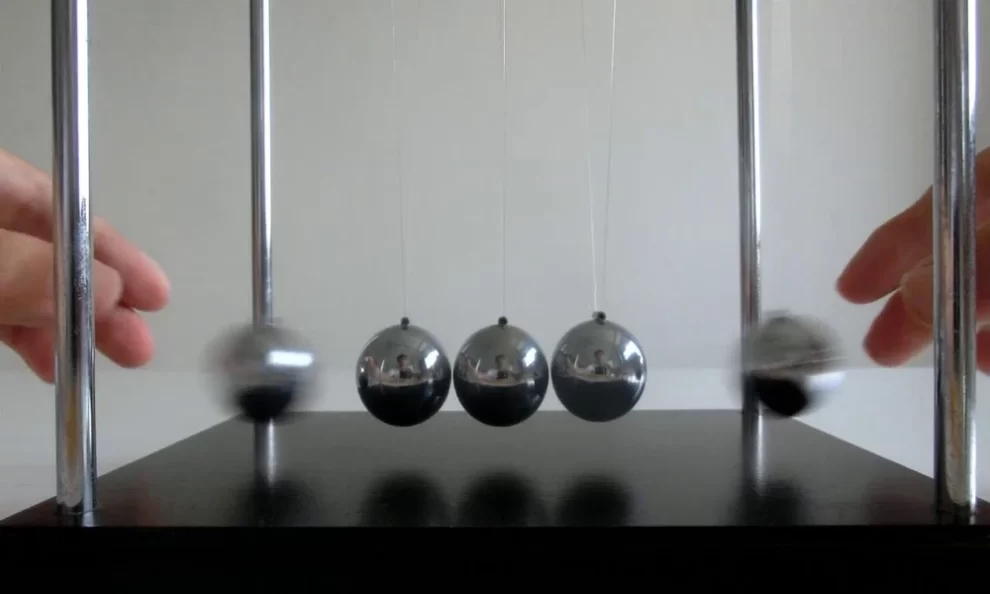

Designed for pre-university physics courses and introductory mechanics labs, the Active Kinetic 1 Newton’s Cradle simulator offers a clear, hands-on way to explore elastic collisions and harmonic motion. Students can test multi-sphere binary setups to observe how impulse and kinetic energy propagate cleanly through a line of steel spheres. Flexible display toggles allow learners to examine momentum and kinetic energy independently or together, reinforcing how both quantities govern every physical interaction.
The Newton’s cradle has retained its appeal as an educational science toy and desktop kinetic sculpture because it combines an elegant design with a striking physics demonstration. A row of polished metal balls hangs in an orderly line; one ball is lifted, released and met by the others, producing the characteristic movement at the opposite end. The rhythmic clicks and alternating swings attract attention, but their real educational value lies in the scientific questions they inspire.
For beginners, the cradle introduces cause and effect, forces and the relationship between movement and energy. Students can investigate why the far-end ball moves, why two released balls often produce two outgoing balls and why the apparatus eventually slows down. These observations provide a foundation for understanding conservation of momentum, kinetic energy transfer, gravitational potential energy and collisions between solid objects.
As learners progress, the same device supports more advanced study. Secondary-school students can investigate the laws of motion and elastic collisions, while university learners can examine impulse, material deformation, damping and differences between ideal models and experimental measurements. The cradle can also encourage discussion of engineering design, including the importance of equal sphere masses, careful alignment and stable suspension geometry.
Its versatility explains why the Newton’s cradle remains useful in classrooms, science museums, STEM activities and home learning. It needs no elaborate setup, gives an immediate visual result and invites repeated experimentation. Although the apparatus cannot demonstrate every aspect of mechanics perfectly, its limitations are themselves educational: they reveal the role of friction, sound and other real-world effects. It is equally well suited to a brief live demonstration or a longer lesson built around predictions, measurements and discussion. The Newton’s cradle remains a timeless learning tool because it makes scientific laws approachable while leaving room for increasingly thoughtful investigation.
Beyond frictionless theory, the simulator provides valuable insight into real-world damping and boundary conditions. Activating the Mechanical Contact Decay mode illustrates how entropic losses driven by acoustic vibrations, heat dissipation, and air drag gradually dampen the pendulum swings. Meanwhile, the Paradox mode serves as an effective analytical check, visually demonstrating why an unequal distribution of mass and velocity violates kinetic energy conservation even when momentum stays balanced.
Newton’s Cradle Simulator
Compare classical mechanical sphere impacts with parallel-face Active Magnetic Cradle (AMC) dipole carriages.
|
Impacts: 0 | Energy Retained: 100.0%






Add Comment